Current protests across France and the geopolitical context which brought us to this point.
Read moreShare a Pencil Day - 20th May 2020
We are delighted to be joining forces with Gulwali Passarlay, Founder of My Bright Kite and award-winning author of The Lightless Sky, for Vent For Change’s annual Share A Pencil Day. This UK wide global education awareness day is taking place this coming Wednesday 20th May and we’d love you to get involved!
The day is designed to teach UK school children some of the key reasons why millions of children worldwide still cannot go to school. This year, adapting to the current health situation, Vent For Change have created a work from home set of lesson plans so everyone can join in. This year for elder children there is a focus on Children on the Move, refugee and displaced children.
Our humanKINDER contribution includes our favourite story from Gulwali’s book about cooking in the mountains of Afghanistan with his grandparents. We have included a simple flat bread recipe for you to cook at home and also the exciting opportunity to be entered in a Prize Draw to feature in our forthcoming Cookbook!
All the learning resources are available to download for free, with accompanying notes for parents, teachers and educators. Please do share this with your friends, family and teachers and use the hashtags #ShareAPencilDay and #RecipesofHOPE2020
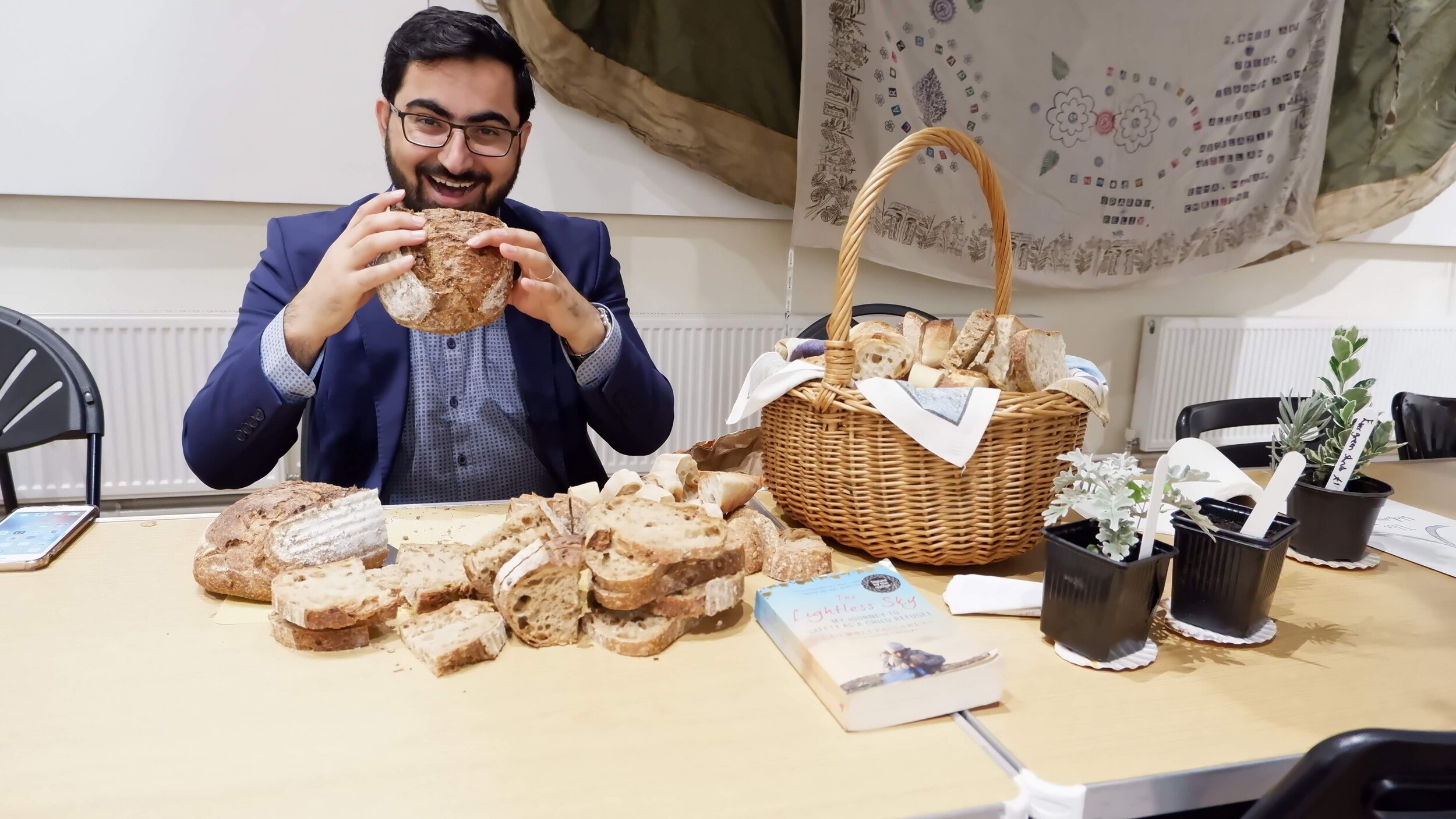
Gulwali Passarlay at The Welcome Tent in Folkestone in October 2019, a community meal to celebrate humanKINDER’s international design research award. Photographed by Debalina Bera.
Thank you to Evan and the team at Vent for Change and Gulwali and the team at My Bright Kite for this partnership opportunity. Thanks to Kyla A. R. Webb from the humanKINDER team for her support in developing the Recipes of HOPE learning resource. For any further enquiries about our work please contact info@humanKINDER.UK
Three actions to dismantle Systemic Racism
Institutional racism still plagues policing, a chief constable has warned
This quote is from an article last month, two decades after the Macpherson Report (1999) found that police failures allowing the racist killers of black schoolboy Stephen Lawrence to escape justice, were in part due to "institutional racism”. I remember it well as at the time I was a Law student studying Race Relations.
Today, as we approach 2019, I have just completed a 16,000 mile journey with my family cooking with and learning from displaced peoples across Europe. Rarely, other than humanitarian volunteers and police authorities, did I see a white face in the makeshift camps and communities where we worked. I would argue that institutional racism goes far beyond the police force in the UK. Even more worryingly there is a surge in far-right activity. A talk given by the Institute of Race Relations’ Director Liz Fekete for a UK Parliament Roundtable on Racism and Hate Crime earlier this year can be read here.
HARLEM
What happens to a dream deferred?
Does it dry up
like a raisin in the sun?
Or fester like a sore-
and then run?
Does it stink like rotten meat?
Or crust and sugar over-
like a syrupy sweet?
Maybe it just sags like a heavy load.
Or does it explode?Langston Hughes
I know from personal experience that if trauma is not acknowledged and healed, it will not go away, but instead will fester. Can the same be said about trauma resulting from systemic racism? As a global society, if we do not acknowledge these entrenched injustice issues and actively facilitate the healing of trauma caused to Black, Indigenous and People of Colour, I do not believe we will ever be able to move forward together, as an inclusive, future-proof global society.
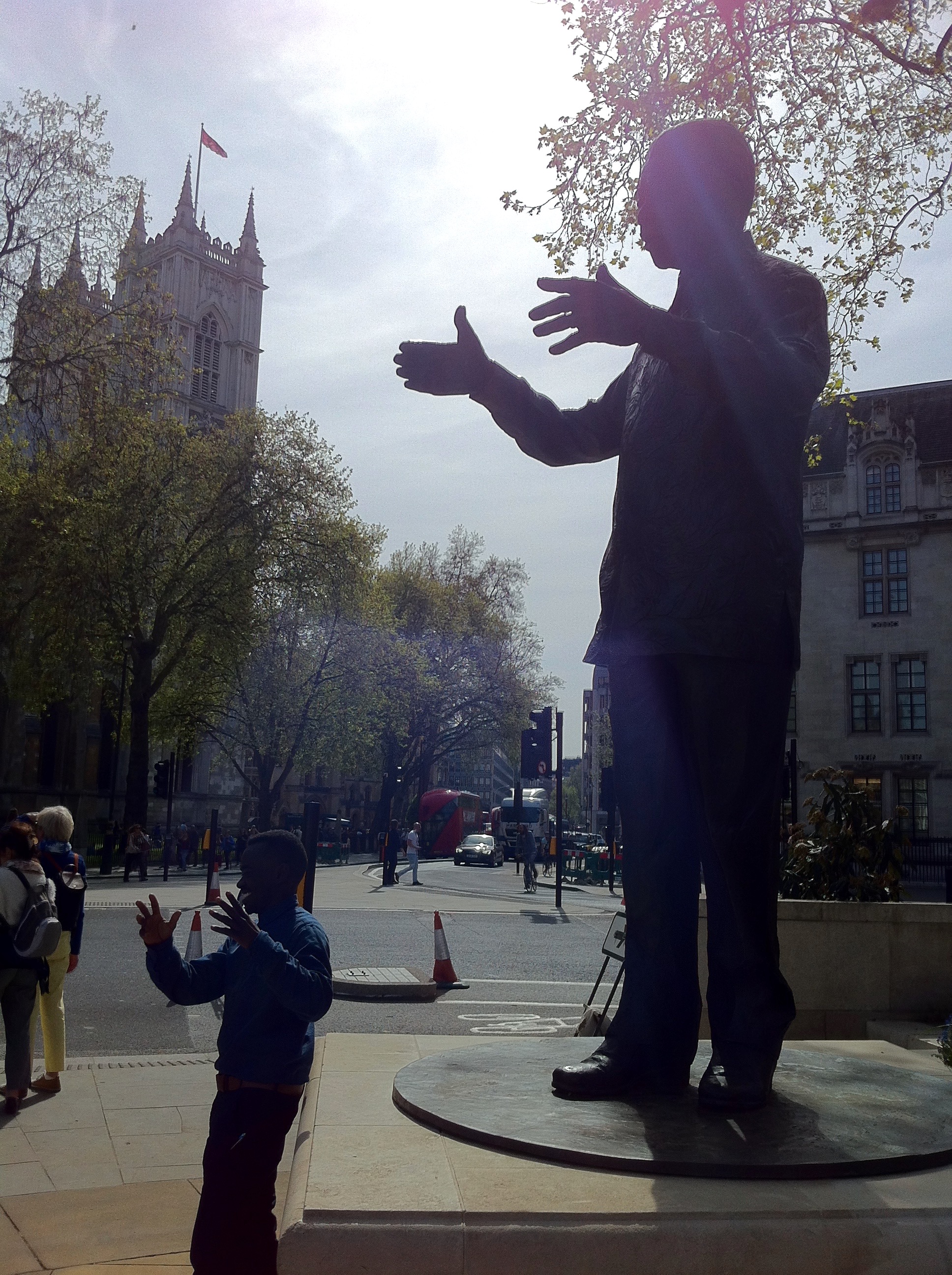
“In our hands”, photograph of Nelson Mandela in Parliament Square, UK on the day of a ‘Calais’ reunion in London, 2016. Photo credit: Emma Barrett Palmer
So as white people, what can we do about it? Starting from today. Now.
We must mindfully use our own privilege to the advantage of everyone in our communities. Dr Willie J. Parker, Ob/Gyn Physician and Reproductive Justice Advocate, describing a group of white women wearing hoodies in protest to a shopping mall, commented,
their practice of the same action without consequence, demonstrates how people with privilege can use it to dismantle the system
Yet this is not simply a case of striding forward again with our own solutions. We must listen to and learn from the solutions that have already been offered by Black, Indigenous and People of Colour, and there are already many. Furthermore, it is not enough to be non-racist but instead "actively anti-racist” as demonstrated through the work of Americans Angela Yvonne Davis, political activist, academic and author and Rachel Cargle and her groundbreaking fund Therapy for Black Women and Girls.
Three tangible actions I can recommend today:
Educate yourSELF - Me and White Supremacy Workbook This first recommendation is a life changing opportunity to support your own role in enabling the healing of Black, Indigenous and People of Colour. A free, yet priceless, download for you, your organisations and your communities. Layla F. Saad has invested her heart and soul into the creation of this work, sharing wisdom from her personal and professional journey to become a better ancestor. The write-up of an incredible Instagram challenge which took place this summer, a universal resource for us all to acknowledge our past, present and how to work together towards building a better, inclusive future for everyone. If you can, please pledge to support her work here and do not attempt to teach this work yourself, paid or otherwise, without carefully reading and understanding the instructions in the workbook.
Educate your KIDS - Teach and Transform I have no hesitation in recommending the inspirational social justice work of this incredible teacher, Ms. Liz KleinRock. The resources do exactly what it says on the tin. Teach and Transform. Check it out.
Educated MEDIA - Building The North Star I first learned of Frederick Douglass, a former slave who launched The North Star, a prohibition newspaper in 1847, in my history lessons. I thought anti-slavery activism was confined to history, but tragically twenty years later I have been proved it is certainly still necessary. With the permission of the Douglass family, Shaun King activist and journalist, and Ben Dixon have revived the newspaper 171 years later. I am proud to be a founding member of this newspaper committed to taking a stand and fighting back against injustice, avoiding venture capitalist investment and co-created by the people, for the people. If you can contribute financially to support The North Star, you will be contributing to an aspiration for a better future. When you decide to join, do mention my name at the checkout.
Finally I want to share this story about Fannie Lou Hamer finding her voice. I hope it will inspire you to find yours on issues of racial injustice in your communities.
In August of 1962, eighteen local people from Sunflower County, Mississippi, including Mrs. Hamer, traveled by bus from Ruleville to the courthouse in Indianola. Despite armed white men milling about the courthouse, the group entered the registrar’s office, intending to fill out the voter registration form as best they could. Mrs. Hamer was the first to enter.
When the group began heading home, the bus–an old school bus now used to transport cotton pickers to the fields–was pulled over by the Indianola police at the edge of town. The driver was arrested for driving a bus of “the wrong color.” Fear rose among the passengers. But in the midst of the fear and uncertainty, Mrs. Hamer began to sing, raising her powerful voice first in church songs, then movement songs. This helped calm the other passengers. Mrs. Hamer’s voice continued to be a powerful tool that mobilized many in Mississippi and across the South during times of struggle in the Movement.
Source: www.humanKINDER.UK
Quisque iaculis facilisis lacinia. Mauris euismod pellentesque tellus sit amet mollis.