
Share a Pencil Day - 20th May 2020
We are delighted to be joining forces with Gulwali Passarlay, Founder of My Bright Kite and award-winning author of The Lightless Sky, for Vent For Change’s annual Share A Pencil Day. This UK wide global education awareness day is taking place this coming Wednesday 20th May and we’d love you to get involved!
The day is designed to teach UK school children some of the key reasons why millions of children worldwide still cannot go to school. This year, adapting to the current health situation, Vent For Change have created a work from home set of lesson plans so everyone can join in. This year for elder children there is a focus on Children on the Move, refugee and displaced children.
Our humanKINDER contribution includes our favourite story from Gulwali’s book about cooking in the mountains of Afghanistan with his grandparents. We have included a simple flat bread recipe for you to cook at home and also the exciting opportunity to be entered in a Prize Draw to feature in our forthcoming Cookbook!
All the learning resources are available to download for free, with accompanying notes for parents, teachers and educators. Please do share this with your friends, family and teachers and use the hashtags #ShareAPencilDay and #RecipesofHOPE2020
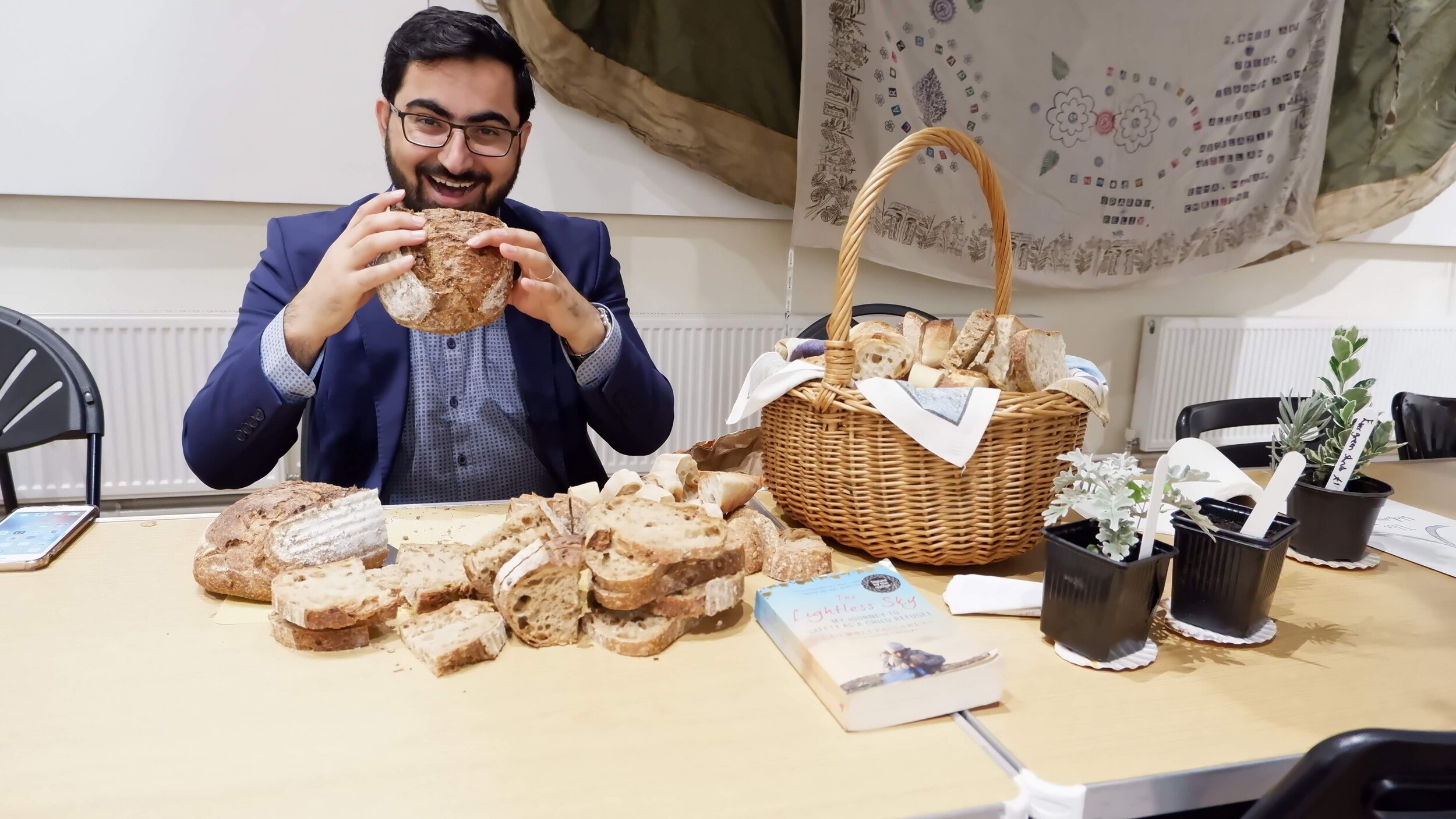
Gulwali Passarlay at The Welcome Tent in Folkestone in October 2019, a community meal to celebrate humanKINDER’s international design research award. Photographed by Debalina Bera.
Thank you to Evan and the team at Vent for Change and Gulwali and the team at My Bright Kite for this partnership opportunity. Thanks to Kyla A. R. Webb from the humanKINDER team for her support in developing the Recipes of HOPE learning resource. For any further enquiries about our work please contact info@humanKINDER.UK
how to mitigate segregation: an unanswered question
On 27 Apr 2019, at 18:46, Eric Kaufmann <e.kaufmann@bbk.ac.uk> wrote:
Dear Emma,
Thanks for your enquiry. I really think this is an unanswered question. We have no real body of successful case studies or data for integration policy that gets beyond small-scale settings (ie classrooms). And I don’t think those small-scale studies - which have also been questioned - really get us to any policies for countries or even cities. Attempts at top-down social engineering have often done more harm than good.
Jeffrey Alexander (2013 in Ethnic and Racial Studies) says somethings similar. Sorry not to get beyond this. I did try and get government funding to run some experiments at ‘nudging’ integration, but haven’t got funding.
Best
Eric
Department of PoliticsBirkbeck CollegeUniversity of LondonWC1E 7HX
twitter: @epkaufm (https://twitter.com/epkaufm)web: www.sneps.netuniversity staff page: http://www.bbk.ac.uk/politics/our-staff/academic/eric-kaufmann
On 27 Apr 2019, at 11:32, humanKINDER <emma@humankinder.uk> wrote:
Dear Eric,
I have just read a very useful article by you on Integration Hub from 05.09.16 regarding the Casey Report, link here http://www.integrationhub.net/majority-avoidance-one-of-the-few-holes-in-caseys-strong-report/.
My current work is about using food as a catalyst to amplify silenced voices, in effect as a tool for integration. I have just completed a year’s field work around Europe cooking with displaced and refugee communities and I am now writing a book. As a trawl though notes from the last couple of years it was this sentence which stood out, and which I’m hoping you may be able to shed further light on: "there is very little grasp in the academic literature of what can be done in free societies to mitigate segregation..."
I find your analysis about housing very useful, but if you were able to point me in the direction of further cases or resources in academic literature that you have found, or indeed where the gaps are, that would be very much appreciated.
Thanks and Kind Regards,
Emma
Quisque iaculis facilisis lacinia. Mauris euismod pellentesque tellus sit amet mollis.